The Price Difference Is Real: How Canada's Drug Pricing System Protects Your Wallet
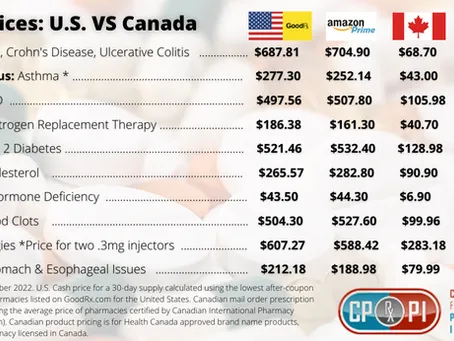
Photo: Canadian pharmacy prescription medication pills price comparison healthcare, via static.wixstatic.com
The Price Gap That Surprises Most People
If you have ever compared the cost of a common prescription medication in Canada to its price across the border in the United States, the difference can be startling. Drugs like insulin, cholesterol-lowering statins, and blood pressure medications can cost anywhere from 30 to 80 per cent less in Canada. This is not a fluke of the market, nor does it reflect any difference in the quality or safety of the medications themselves. Rather, it is the direct result of deliberate policy choices embedded in Canada's pharmaceutical and healthcare regulatory structure.
At Canadian Pharmacy Online HQ, we believe that informed patients make better healthcare decisions. Understanding why Canadian prescription prices are lower — and what that means for the medications you receive — is a meaningful part of that knowledge.
The Patented Medicine Prices Review Board: Canada's Price Watchdog
At the heart of Canada's drug pricing framework sits the Patented Medicine Prices Review Board (PMPRB), a federal quasi-judicial body established under the Patent Act. The PMPRB has the authority to review the prices of patented medications sold in Canada and to intervene when those prices are deemed excessive relative to international benchmarks.
Under this framework, pharmaceutical manufacturers cannot simply charge whatever the market will bear for a newly patented drug. Instead, prices are measured against those in a basket of comparator countries, including France, Germany, Sweden, and the United Kingdom. This external reference pricing mechanism creates a structural ceiling on what companies can charge Canadian consumers, a mechanism that simply does not exist in the United States.
In the U.S., pharmaceutical companies operate in a largely deregulated pricing environment. There is no federal agency empowered to cap the launch price of a new drug. Manufacturers negotiate separately with private insurers, pharmacy benefit managers, and government programmes like Medicare — but no single authority enforces a national price limit. The result is a system where drug prices are set primarily by market leverage rather than public interest oversight.
Government Bulk Purchasing and Provincial Formularies
Beyond federal oversight, Canada's provinces and territories each maintain their own drug benefit programmes, which cover eligible residents for certain prescription costs. These provincial formularies — essentially approved lists of covered medications — give provincial governments significant purchasing power when negotiating with drug manufacturers.
When a province agrees to list a medication on its formulary, it typically does so only after negotiating a confidential rebate or price reduction with the manufacturer. The pan-Canadian Pharmaceutical Alliance (pCPA), a collaborative body representing most provincial and territorial governments, conducts joint negotiations on behalf of multiple jurisdictions simultaneously. This collective bargaining approach amplifies the leverage of any single province, resulting in lower net prices for publicly funded drug programmes.
This model is fundamentally different from how the United States has historically approached drug purchasing. Until relatively recent legislative changes, Medicare — the U.S. federal programme covering seniors — was explicitly prohibited by law from negotiating drug prices directly with manufacturers, a restriction that cost American taxpayers and patients enormously over several decades.
Patent Laws and Generic Drug Access
Patent policy is another critical lever in the pricing equation. In Canada, once a drug's patent expires, generic manufacturers are permitted to produce equivalent versions of the medication, provided they demonstrate bioequivalence to the original. These generics typically enter the market at 25 to 40 per cent of the brand-name price, dramatically reducing costs for patients and provincial drug plans alike.
Health Canada, the federal department responsible for pharmaceutical regulation, rigorously evaluates both brand-name and generic medications before they are approved for sale. A generic drug must meet the same standards for safety, efficacy, and quality as its branded counterpart. The lower price of a generic does not indicate a lesser product — it reflects the absence of the original research and development costs that the brand-name manufacturer has already recouped.
In the U.S., brand-name manufacturers have historically employed a range of legal and strategic tactics — sometimes referred to as "pay-for-delay" arrangements — to prevent or postpone generic competition. While regulatory bodies have pushed back against some of these practices, the result has been a slower and less consistent introduction of affordable generics compared to Canada.
Addressing the Safety Question Directly
A misconception that occasionally circulates, particularly among those unfamiliar with Canadian healthcare, is that lower drug prices must somehow imply lower quality or less rigorous safety standards. This is categorically false.
Health Canada subjects every medication approved for sale in this country to a thorough review process that evaluates clinical trial data, manufacturing practices, labelling accuracy, and post-market surveillance requirements. The standards applied are consistent with those of other leading regulatory authorities globally, including the U.S. Food and Drug Administration (FDA) and the European Medicines Agency (EMA).
Pharmacies operating in Canada — including online pharmacy services — are subject to provincial licensing requirements and must adhere to professional standards set by provincial regulatory colleges. Dispensing pharmacists are required to hold valid licences and to practise within established scopes of care. When you fill a prescription through a licensed Canadian pharmacy, you are receiving a medication that has met the same internationally recognised quality benchmarks as any drug dispensed elsewhere in the developed world.
What This Means for You as a Canadian Patient
For Canadians, this regulatory environment translates into tangible, everyday savings. Whether you are managing a chronic condition that requires ongoing medication, filling a short-term prescription following an illness, or exploring options for a family member, the Canadian pharmaceutical system is structured with your affordability in mind.
Online pharmacy services have further expanded access to these advantages by eliminating geographic barriers. Canadians in rural or remote communities, those with mobility limitations, or individuals who simply prefer the convenience of home delivery can now access licensed pharmacy services without sacrificing professional oversight or medication quality.
At Canadian Pharmacy Online HQ, we operate within this regulated framework, connecting Canadians with trusted medications dispensed by licensed professionals. Our model is built on the understanding that access to affordable, high-quality prescription medications is not a luxury — it is a cornerstone of good health.
The Broader Picture: Why the Disparity Persists
It is worth acknowledging that the pricing gap between Canada and the United States is not simply a matter of one country doing things right and the other doing them wrong. The U.S. pharmaceutical industry argues that higher prices fund the innovation that produces new treatments benefiting patients worldwide. There is some validity to this argument — a disproportionate share of global pharmaceutical research and development spending does originate in the United States.
However, the human cost of that model — measured in patients rationing insulin, skipping doses, or forgoing treatment altogether — has prompted significant public and legislative debate south of the border. Canada's approach represents a different set of priorities: one that accepts a degree of trade-off in exchange for ensuring that medications remain accessible to the population at large.
Understanding this distinction helps Canadian patients appreciate not only the savings they enjoy, but the policy infrastructure that makes those savings possible — and the importance of supporting and maintaining that infrastructure for future generations.